ENRIO Webinar: Ten Years of Council Conclusions on Research Integrity in Europe
1 December 2025 | 15:00–16:00 CET | Online (Zoom)
The ENRIO webinar “Ten years of Council Conclusions on Research Integrity in Europe” took place on Monday, 1 December. We were delighted to welcome so many of you and to celebrate this important milestone together.
If you missed the event, do not worry: You will find bellow a short a summary of the discussion, and a longer version of the key messages and outputs from the webinar will later be shared.
Make sure to Follow ENRIO on LinkedIn to stay updated.
Summary – ENRIO Webinar
Ten Years of Council Conclusions on Research Integrity in Europe
Looking back and forward
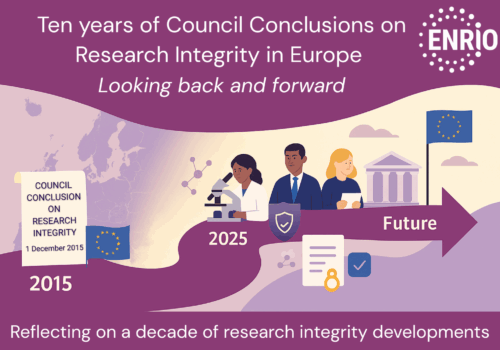
On 1 December 2025, ENRIO hosted a webinar to mark the 10th anniversary of the 2015 Council Conclusions on Research Integrity. The event brought together leading European and international voices to reflect on the major developments of the past decade and to discuss priorities for the years ahead.
The rich discussion brought by our esteemed panelists, Maura Hiney, Dorian Karatzas, Robert Kerger, Iryna Degtyarova, Mariëtte van den Hoven, guest speakers Robbert Dijkgraaf and James Morris, and chairs Carole Chapin and Bert Seghers highlighted that the 2015 Council Conclusions were “a turning point”, bringing political visibility, shared commitments, and momentum for strengthening research integrity across Europe. They recalled how the Conclusions helped transform a previously fragmented landscape: national bodies were established or professionalised, networks like ENRIO gained structure and visibility, and the European Code of Conduct grew into “a widely acknowledged reference” for good scientific practice. The Council Conclusions also accelerated the integration of integrity into European funding programmes, institutional procedures, doctoral training and open science reforms. As highlighted by several panelists, this decade saw research integrity become embedded not only in high-level policy but in everyday practice: universities built dedicated support structures, funders aligned their expectations, publishers reinforced standards, and early career researchers engaged more actively with integrity frameworks. This collective evolution—moving “beyond tick-box approaches” to coherent national and European ecosystems—has laid the essential groundwork for facing the new challenges ahead.
The speakers reflected on a decade of progress in research integrity and the challenges that lie ahead in an era of rapid technological and geopolitical change. It was noted that Europe, as a collaborative, values-driven space for research, now faces a shifting landscape where science is expected to underpin political decisions but institutions must navigate “difficult boundaries” at the science–policy interface. The rise of AI was described as a turning point—a “singularity moment”—that may require redesigning how universities foster and safeguard responsible research. This reinforced the need for strong institutional cultures—“the fertile ground on which integrity grows”—supported by robust infrastructures, early and engaging training, and clearer guidance for researchers at all levels. Discussions also highlighted the importance of working across disciplines and with non-academic stakeholders while ensuring that integrity standards remain clear and meaningful. Geopolitical tensions and research security were framed as delicate balancing acts, requiring vigilance. Throughout the discussion, participants called for greater coordination across Europe, more harmonised training resources, stronger evidence on what works, and shared platforms for learning from both successes and “brilliant failures.” Together, these reflections underscored that the next decade of research integrity will demand collaboration, adaptability and a renewed commitment to support openness, academic freedom and trustworthy research.
Thank you to everyone who joined us!
For the upcoming and materials, make sure to follow ENRIO on LinkedIn.